

What is meant by “gravimetric distance”?
Imagine three targets: Target B is at the same height as the shooter. Target A is higher and Target C is lower. Yet all three are the same distance away in a straight line. The equal-length orange lines and the shared circular arc show this.
Same direct distance, different horizontal distance
All three targets are directly 1,000 m / 1,093.6 yrd from the shooter.
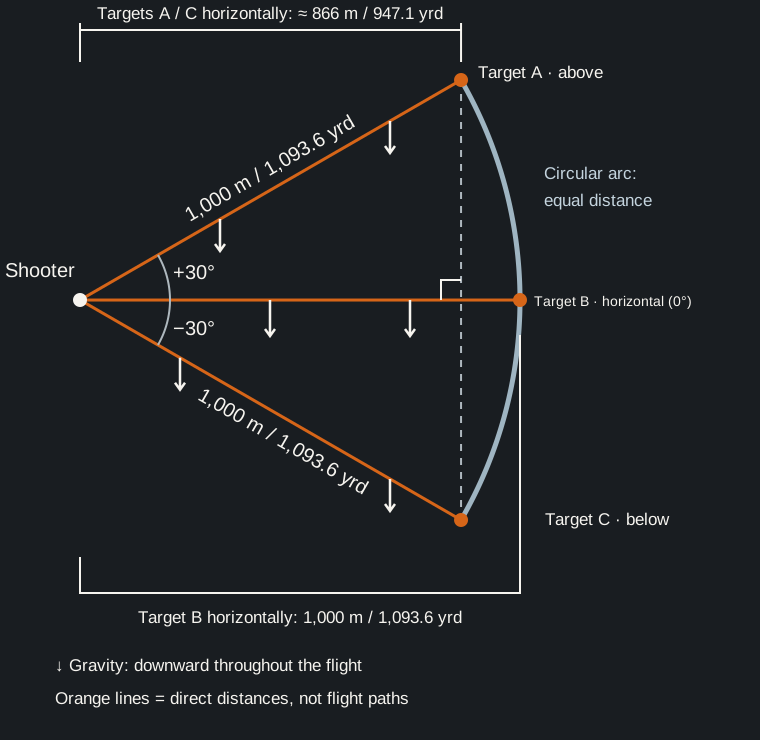
The three orange lines have equal length. Target A is above the shooter, Target B at the same height and Target C below. The circular arc shows that none is nearer or farther in a direct line.
Horizontally, A and C are about 866 m / 947.1 yrd away; B is 1,000 m / 1,093.6 yrd away. The dashed line helps identify the horizontal projection.
The white arrows show gravity acting downwards everywhere. A shorter horizontal distance does not mean less time in the gravitational field. With an inclined direction of travel, downward gravity acts at a different angle relative to that movement than in horizontal flight. The actual flight time cannot be read from this distance diagram.
The orange straight lines show distances, not bullet trajectories.
Diagram: Weitschuss · simplified distance example; rounded values
Imagine three targets: Target B is at the same height as the shooter. Target A is higher and Target C is lower. Yet all three are the same distance away in a straight line. The equal-length orange lines and the shared circular arc show this.
What does “direct distance” mean?
It is the straight connection from the shooter to the target, as if a string were stretched between them. A laser rangefinder initially measures this distance. It is also called line-of-sight distance.
What does “horizontal distance” mean?
It is only the horizontal separation. Imagine looking down on the diagram from above: the difference in height would no longer be visible. In that view, Targets A and C are closer to the shooter than Target B. Their direct distance nevertheless remains the same.
So what is “gravimetric distance”?
The term is sometimes used for this horizontal separation, but it has no uniform definition. We therefore use the more precise term “horizontal distance” here. Gravity acts on a bullet throughout its flight, including when it travels upwards or downwards.
Why might a rangefinder display another value?
Some instruments also calculate a comparison value for a situation without a height difference. Besides distance and angle, they may take other information into account. Depending on the manufacturer, this may be called “ballistically equivalent distance”, for example. It need not match the horizontal separation in our diagram.
Remember: direct distance runs straight to the target. Horizontal distance describes only the horizontal separation. The instruction manual explains which of these values your instrument is displaying.